


Sajad Hameed is a Kashmir-based visual journalist and multimedia storyteller from India. He covers stories about the changing climate, as well as a range of topics, across South Asia.
Rehan Qayoom Mir is a Kashmir‑based freelance journalist whose reporting has focused on landscapes, conflict, culture, politics and social issues.
LADAKH, India — High on the wind-swept plains of the Changthang plateau, in Ladakh, along the northern tip of India, the world seems untouched by time.
Changthang, Tibetan for “Northern Plateau,” stretches across Ladakh into western Tibet, a seemingly barren expanse of stone, salt and sky. It is a high-altitude desert where life has adapted over centuries to harsh winds, scarce water and extreme cold.
Yaks lumber across the dusty mountain earth, their breath rising in clouds. Behind them, Thinlay Nurboo, a yak herder, holds a handmade rope with a small stone tied to its end in his hand. Nurboo throws the stone forward to startle approaching wild animals and keep his yaks safe.
For generations, the people of Ladakh have shaped their lives and cultural practices around the mountains, farming barley on limited arable land and managing increasingly scarce glacial water that relies on once-regular snowfalls.
“Today, those rhythms are broken,” Nurboo says.
Ladakh, often romanticized for its stark beauty and Buddhist monasteries perched on cliffs, is now a frontline in the global climate crisis. In just the last few decades, villagers speak of winters that arrive late and leave early. Glaciers that fed entire valleys have shrunk into bare rock. Streams that once ran through the summer months dry up by mid-June. In most places, the land is turning to dust.
Local Ladakhi communities, supported by engineers and environmentalists, are building artificial glaciers and reviving ancient water systems to sustain water for agriculture. But the future remains uncertain. A high-altitude desert that once depended on the stability of seasons is now caught in the chaos of a warming world.
Beyond environmental challenges, the march of modernity is changing how people view their own lives. Education, urban jobs, tourism and new technologies offer opportunities, but they also shift values, creating subtle pressures that make traditional practices seem outdated or less respected.
“In Tibet, under Chinese occupation, the erasure of Tibetan culture was violent,” Sonam Wangchuk, an engineer and environmentalist known for his work on Ladakh’s water systems, said. “But in Ladakh, it is different. Here, traditions like yak herding are vanishing quietly, without force.”
The traditional semi-nomadic way of life herders like Nurboo live — a delicate balance of reciprocity with land and animals — is quietly unravelling under the pull of modernity and the pressures of climate change and militarized geopolitics.
In Changthang, yak herders are increasingly viewed as backward, their dialects ridiculed, and this makes getting married difficult, explained Nurboo, who looks younger than his 35 years. The stigma is often a stronger force than economics. People abandon herding not because it cannot sustain them, but because they begin to feel inferior about their way of life.
“Once that happens, a culture can disappear without a single act of violence,” Nurboo tells us.

A Vanishing Way of Life
On the high-altitude plains of the Himalayas, wind gusts, and the air is sharp with cold, even though it is mid-June. Nurboo follows a moving herd of yaks a couple of miles from his nomadic farm. His boots are wet with yak dung from traversing the higher mountain peaks in search of grazing land.
Unlike other livestock, yaks require specialized care, high-altitude grazing and seasonal migrations across rugged terrain. While goats, sheep and cows are still herded at lower altitudes, yak herding is increasingly rare. Local elders believe Nurboo is one of the last practicing yak herders in the region, keeping the centuries-old tradition that has quietly structured life in the upper Himalayas.
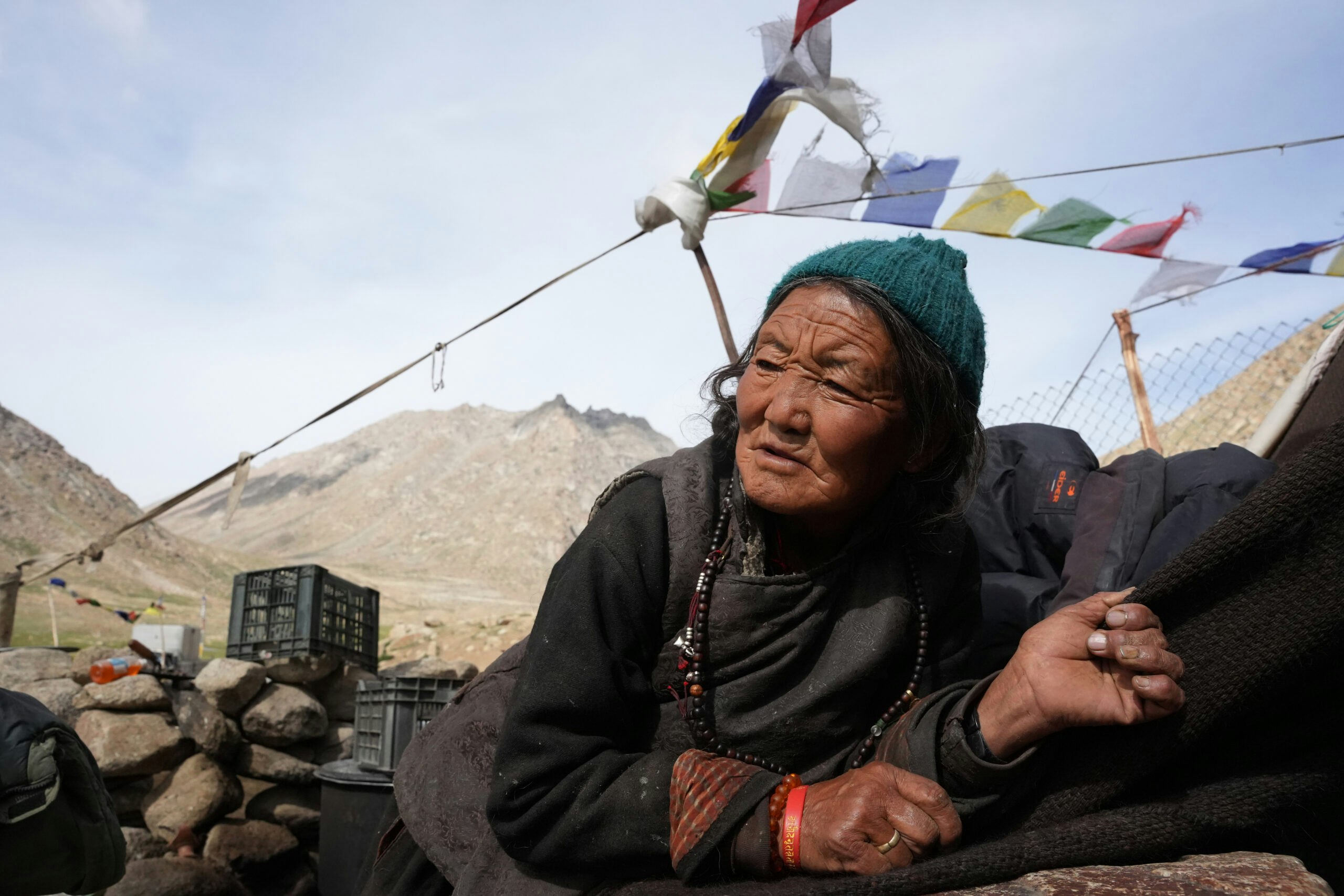
“Not everyone today wants to live this way,” he says, sitting inside a tent he and his father made. His home is a traditional rebo, crafted from hand-woven yak hair and wool by Changpa nomads. Durable and insulating, it serves as shelter during seasonal migrations.
“In recent years, some families have added simple side sheds, semi-permanent stone or tin structures, or modern canvas tents for storage and daily chores,” Nurboo tells us, continuing to live in the traditional style. “They call it backward, and the people, especially the younger generations, [don’t] want to follow this tradition.”
These days, Nurboo cares for 90 of his own yaks and around 100 yaks belonging to villagers who have left herding.
The government has worked to support herding communities by resettling them in more strategically located border villages under the Vibrant Village Programme. Meanwhile, promises of salaried work have drawn people to Ladakh’s capital, Leh, roughly 130 miles away, or to the town of Srinagar, about 260 miles away.
“Ladakh, often romanticized for its stark beauty and Buddhist monasteries perched on cliffs, is now a frontline in the global climate crisis.”
Yak herding in Ladakh has always been harsh, but it was also once richly communal, with families migrating together in loose caravans, setting up winter camps in valleys and summer tents near alpine meadows.
Here, like in Tibet and the higher parts of the Himalayas, songs marked seasons; grazing rhythms aligned with star charts and snow patterns. Children grew up learning to read the wind by listening to silence, to find medicine in plants and to stitch wool without waste. It was a way of being that trained people to be patient and observe deeply.
Yak herding, from the perspective of modernity, appears inefficient. Why move with animals across frozen plains when trucks can deliver feed? Why live in tents when cement houses are subsidized? Yet in its so-called inefficiency lies its genius.
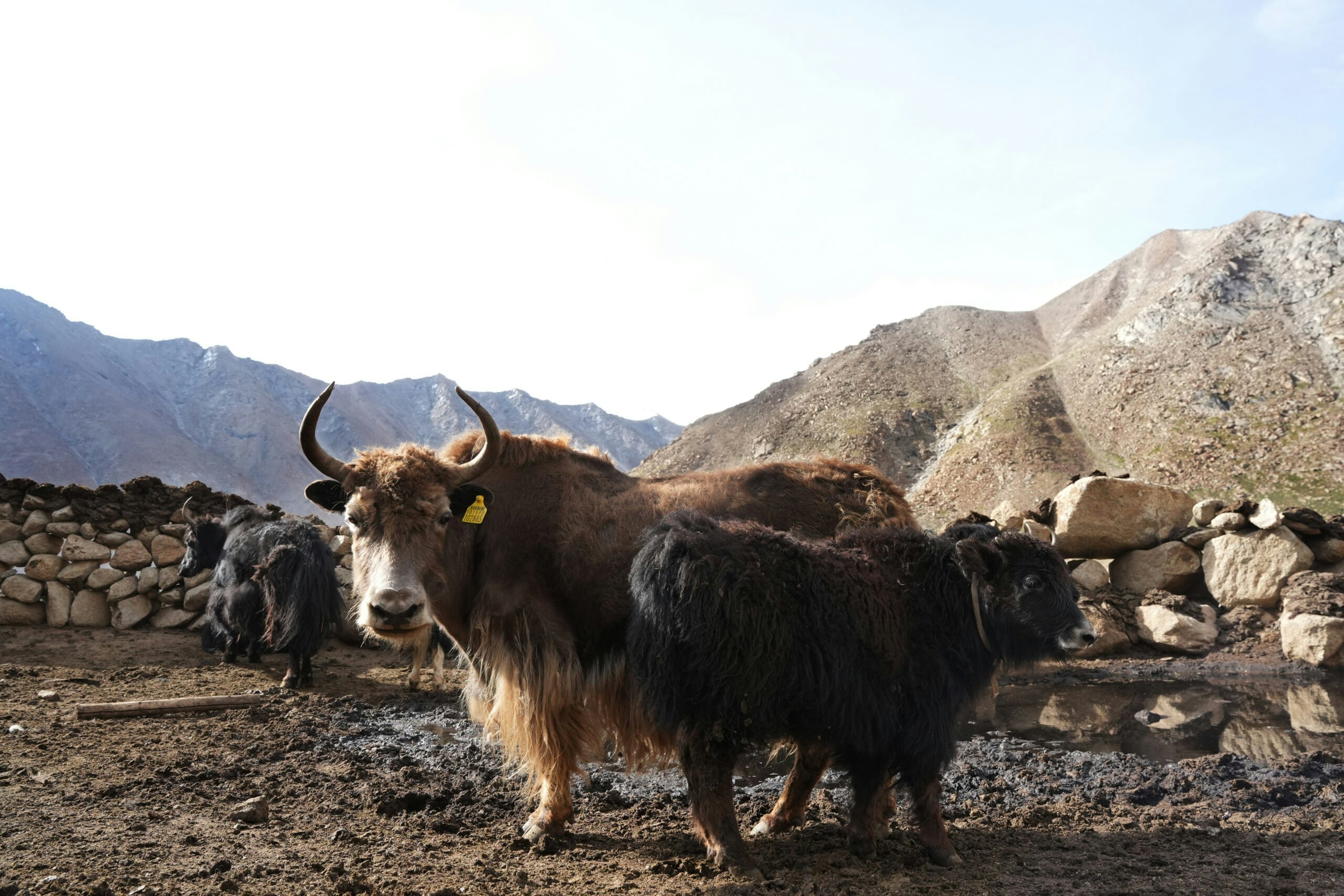
Herders like Nurboo leave a minimal carbon footprint. They use every part of the animal — its meat, hide, milk, dung and even its horn. Their movement prevents overgrazing.


Where Ecology is Sacred
At an average elevation of nearly 15,000 feet, Changthang is one of the highest inhabited regions on Earth. Temperatures drop below minus 22 degrees Fahrenheit in winter; air pressure at this altitude is significantly lower than at sea level, meaning each breath contains far less oxygen.
Despite its extremes, it has long sustained semi-nomadic herders like Nurboo, who have adapted to the plateau’s rhythms over centuries by collaborating with it. But sustaining those rhythms has required a lot more work lately.
“We never used to climb this high,” said Sonam Dogree, a herder we met just above Satto village, a small hamlet high on the Changthang Plateau, her goats trailing behind her on a mountain path. “The lower pastures were enough. But now the grass is disappearing down there. The weather no longer follows the seasons we knew. We have no choice but to keep moving upward. Ladakh is changing, and we feel it at every step.”
But the effects of climate change here are more subtle to the eye than in other regions where you see droughts or floods, Dogree explains, “that’s because Changthang has no great rivers — only wide plains.”
High up in the mountains, a stream that typically freezes during the harsh winter months now flows freely in June. “What we notice is less snow in winter and more rain in summer,” Dogree continues. The high-altitude land means Changthang has a short growing season, and most vegetation relies on spring moisture to germinate and grow.
The shift to less snow in winter and more rain in summer means that, by the time spring arrives, there is not enough moisture in the soil for crops and vegetation to germinate properly. Although summer brings some rain, it is often too late or too little, leaving crops short of water by autumn.
The Indian Himalayas, part of the greater “Third Pole” region that includes the Tibetan Plateau and holds the largest ice reserves outside the polar regions, are warming at nearly twice the global average.
According to a 2023 study by the intergovernmental International Centre for Integrated Mountain Development (ICIMOD), the larger Hindu Kush-Himalaya — which includes Ladakh — is experiencing significant warming-triggered extreme weather events, including floods, landslides and erratic rainfall, which have become more frequent and severe in recent decades.
“These are ecosystems that evolved under predictable cycles. The glaciers are melting, the weather patterns are changing, and we can see it with our naked eyes,” said Sonam Lotus, the director of Ladakh’s meteorological department in Leh and a famous climatologist.
These erratic conditions mean calves are born in awkward months, out of sync with pasture availability. Grasslands dry up faster. Snow comes late and sometimes all at once.
“Some years there is too much snow, burying the grasses so that animals cannot graze,” Dogree says. “Starvation follows. Whether this is climate change or a cycle that has always existed is difficult to say.”


Sacred Geography Meets State Logic
Over the past two decades, the Changthang has become increasingly entangled in the geopolitical anxieties of modern states, particularly as tensions along the disputed India-China border remain unresolved despite decades of diplomacy.
Since the 1962 Sino-Indian War, the Line of Actual Control (LAC), an ambiguous, contested border between India and China, has sliced across traditional herding corridors. Unlike formal borders, the LAC that demarcates the India-China border is unmarked and often contested, shifting with patrols, perceptions and politics.
“The traditional semi-nomadic way of life herders like Nurboo live — a delicate balance of reciprocity with land and animals — is quietly unravelling under the pull of modernity and the pressures of climate change and militarized geopolitics.”
In 2020, deadly clashes between Indian and Chinese troops in the Galwan Valley brought global attention to this desolate region. But for locals like Nurboo, the consequences of these clashes have had a cumulative impact on daily life.
“Every time tension rises, we lose more land,” Nurboo says. “They say it is for our safety. But who asked us?”
Satellite surveillance, bunkers, airstrips and newly paved roads have turned open range into a militarized landscape. “Entire migration routes must be redrawn,” Dogree explains. “Life for herders is harder, not only because of nature, but because of borders closing in.”
Since the mid-2000s, the Indian government has invested heavily in road-building along the LAC. Projects like the Durbuk-Shyok-DBO road that connects Ladakh’s capital, Leh, with the Daulat Beg Oldi military post near the China border, and improvements along the north bank of Pangong Tso Lake, have turned what were once mule tracks into asphalt arteries, enabling faster troop movement, logistics support and year-round access to remote border areas.
Nurboo points to a road near the Pangong Tso Lake. “We used to take the yaks there during the summer. Now it is closed — the army says it is sensitive.”
The land, once mapped by grass and stars, is now coded in red zones and restricted access points. The result is not only physical displacement, but an erosion of memory. Younger herders no longer walk the full length of traditional routes; some don’t even know them.
“Our ancestors moved like the wind,” Nurboo says. “Now even the wind cannot pass without permission.”
The transformation of the landscape is also symbolic. Researchers note that state conservation and protected‑area policies — including the establishment of conservation zones, wildlife sanctuaries and other conservation measures — have often restricted pastoralists’ access to lands they have stewarded for centuries, reflecting broader tensions between conservation objectives and traditional land use in mountain regions.
In some areas, herders are not allowed to access ancestral pastures. The logic of militarization and its requisite infrastructure, unlike the logic of herding, does not bend to seasons or ecology.
“It is ironic, because herders are among the few people who still know how to live within ecological limits,” Nurboo notes. “But development models do not value that kind of knowledge.”
One of the most profound losses facing Changthang’s pastoral culture is the disappearance of its oral cartography.
During Nurboo’s childhood, the landscape was alive with names. Each boulder, hillock, or watering hole had a name, a story or a warning to go along with it. This was not just folklore but guidance anchoring people to place.
Today, fewer young people can recite these placenames. Many of the stories remain undocumented. When elders pass away, so do their maps. The land becomes, in the bureaucratic sense, “empty” again: easier to rename, redraw or repurpose.
Militarization has also brought unintended ecological consequences. Roads increase erosion and runoff, altering water patterns. Construction crews disturb migratory paths of snow leopards and Bharal (Himalayan blue sheep). The growing number of diesel-powered vehicles has brought pollution into once-pristine valleys.
Yet for some in Ladakh, the military also offers opportunity. A regular income, health care and housing, things the pastoral life cannot reliably provide. Youths from herding families now sign up as porters, road workers or even low-ranking soldiers.
“My brother is in the Army,” said Sereen Dolma, a teenage girl from Sultak, a remote village on the Changthang plateau. “I am thinking of leaving herding, too.”
She stood in a vast open grazing ground, surrounded by over 200 Pashmina goats. Her face was partially hidden behind a scarf, part shyness, part habit.
Dolma had returned home for the summer, helping her family tend their herd as generations before her had done. But her dreams, like many among the younger generation of Changpa nomads, now stretch beyond the high-altitude pasturelands.
“I’m studying in Leh,” she said quietly. “I want to be a pilot one day.”

The Lure Of Modernity
On an evening in Leh, we met Lukzi Tsering, a woman who appeared to be in her 30s, sitting cross-legged near the Leh market, absorbed in a mobile game on her smartphone.
Her father was a herder. So was her grandfather. But Lukzi has no intention of following that path.
“I run this jewelry stall in the Ladakh market, and I love what I do,” she said, adjusting a display. “I also take photos and post on my Instagram and YouTube channels. That is just my thing.”
“Calves are born in awkward months, out of sync with pasture availability. Grasslands dry up faster. Snow comes late and sometimes all at once.”
In Leh, high-speed internet, cafe culture, and Instagram-ready landscapes offer a seductive counter-narrative to pastoral hardship. There are government jobs, gig work with trekking agencies, driving tourists to Pangong Lake. There is also a little nightlife, music and visibility.
There is also education, long seen in society as the ladder to progress. In many remote parts of Ladakh, children often travel to towns such as Leh and Kargil for schooling, supported by initiatives like the 17000 ft Foundation to improve conditions in isolated hamlets. Some families send their children further afield to study, with scholarships helping students attend institutions in places such as Jammu, Delhi, or even abroad, through government scholarship programs. And while this opens doors, it also widens the gap between generations — and often leads to more exits from pastoral life.
At a secondary school in Choglamsar, just outside of Leh, we interviewed six students from herding families. None intended to return. “My parents don’t understand what I do,” said one girl, a senior secondary school student. “They talk about goats and winds, and I talked about mobile phones and books.”
Still, many parents want their children to have more stability and seasonal certainty, especially given the changing climate. “Even I don’t want my son to herd,” said a 40-year-old former herder in Durbuk, a village nearly 86 miles northeast of Leh. “It is too hard. Too lonely. And it gives you nothing.”


A Culture Without Heirs
In one of the villages of the Changthang plateau, one-storied houses sit beside nomadic tents. Alongside them, couples manage herds once maintained by five or six families.
Many of the families we spoke to recalled sending their children to larger towns and cities for better opportunities or to join the army for a stable income, and the prevalence of empty houses in the region underscored this trend. Others chose to sell their livestock altogether.
In Hanle village, we met a 62-year-old woman, Yangdol Dolma, who now treks the pastures alone. “One of my sons works at a resort in Leh, and the other is in the army,” she told us.
Herding had become increasingly difficult as once-thriving grazing lands have vanished, Dolma said, her voice quiet with resignation. Yaks and sheep have succumbed to the unforgiving impacts of a changing climate.
“Yaks prefer cold climates,” she said. “But Ladakh’s cold desert is warming, and they are being forced to climb higher in search of colder pastures and grazing grounds. Sadly, many don’t survive.”
In Phyang village outside Leh, we met Wangchuk, the engineer and educator best known for his “Ice Stupa” innovation — an artificial glacier designed to store winter meltwater and release it slowly in spring, helping farmers irrigate their fields when water is scarce. But Wangchuk is more than an inventor. He is an environmentalist shaped by Ladakh’s fragile ecologies.
Over tea, he reflected on the disappearing pastoral way of life. “One of the beauties of Ladakh is how people live in total harmony with nature, whether shepherds, herders or farmers,” he said. “Few means, high contentment.”
For him, the erosion of grazing traditions is not just an economic loss; it is the loss of a way of life that has lasted thousands of years. Displaced herders end up in cities, uprooted from the very support systems that sustained them. And once disconnected, it is hard to return.
Wangchuk sees this shift as spiritual, not just social. “Buddhism teaches us to live simply, without harming nature. That’s now being challenged by a development model driven by economy and commerce.”
By choosing to remain a yak herder, Nurboo embodies a kind of defiance against the growing tide of migration to cities in search of comfort or greener pastures. These herders have also blended their ancestral traditions with their new reality, opening their world to visitors who can experience their animals, their daily lives and the products of their labor.
In doing so, herders are not only able to secure an additional source of income but also reimagine tradition itself, turning it into a pathway not of survival alone, but of thriving, Nurboo explained.
Karma Sonam, a Ladakhi historian, has spent decades documenting the oral histories of Changthang’s pastoralists and frames what is being lost here starkly.
“When we lose yak herding here, we are not just losing an occupation, but we are losing an entire library — written not on paper,” Sonam told us by phone. Those details are in the wind, in the way clouds gather, in the names of stones and streams.
“When elders pass away, so do their maps. The land becomes, in the bureaucratic sense, “empty” again: easier to rename, redraw or repurpose.”
“These are not just grazing lands,” he explained. “They are memory slopes. They hold the instructions for how to live here without destroying it. Once forgotten, those instructions are almost impossible to recover.”
Drawing on both Buddhist philosophy and indigenous Ladakhi thought, Sonam insists that pastoralism is not a relic of the past but a “living treaty” between humans and the non-human world — one that cannot be renegotiated once broken.
Yet what has troubled him most is how unnoticed such a loss would likely be.
“A tradition can die without a funeral,” he said softly. “And when it does, the land may still look the same — but it will no longer know our names, and we will no longer know its.”


Archive Of A Disappearing World
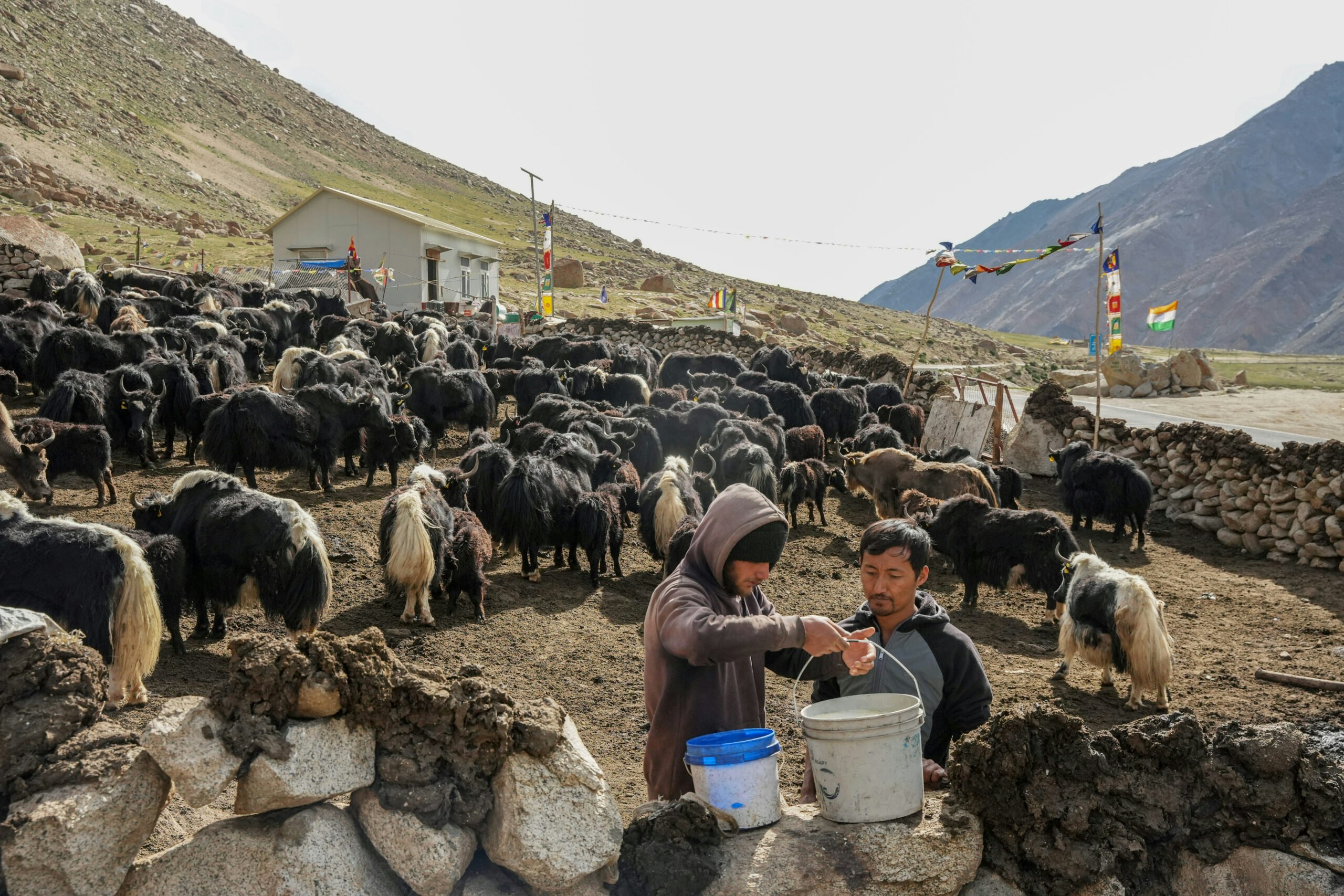
When we first met Nurboo, he was wrapping up milking his yaks on his nomadic farm, a task he had started around 6 a.m. He stood among his herd — hundreds of black and brown, long-haired beasts with patient eyes — as each waited its turn. By 9 a.m., he was finished, and they were all released to the pasture.
In Changthang’s high-altitude villages, even stone houses appear to tremble against the winter wind. Nurboo is regarded by villagers with a mixture of reverence for his dedication to tradition and pity for the hardships he endures.
Inside Nurboo’s black yak-haired tent, roughly 15 to 20 feet across, the open space is divided into functional areas. A small desk and a few essentials mark his personal area, a private corner for work and planning.
The smell of dried yak dung drifts through the panels, while his farm lies just beyond the tent. Family members, like his mother or aunt, may sleep in other parts of the tent or in nearby seasonal shelters, but this corner remains Nurboo’s private workspace.
Close by stood his single-story house, where his mother and aunt sat sipping Gur Gur chai — the salty butter tea of Ladakh — from khos, traditional cups.
Beside them, a gas stove hissed as Nurboo, his cousin Ungan Thustop, and his mother, Kunzis Dolma, prepared yak milk to be made into curd, butter and dry cheese.
“This is my routine,” Nurboo explained as he hefted a large drum of milk and poured some into a beaker. His cousin, meanwhile, stirred and extracted the butter with a traditional churn, a hand-operated wooden device common in Ladakhi households.
From morning until noon, he and his family process the day’s yield into butter, curd and hard cheese. Then, packing his lunch, he follows his herd into the mountains, keeping watch for wild animals like snow leopards or wolves that might strike. He carries his handmade slingshot-like rope with a small stone tied to its end.
Years of herding have sharpened his instincts; he can sense danger from subtle cues in the wind or the herd’s restlessness. “Out here,” he says, “you don’t wait to see the animal — you act before it does.”
By 6 p.m., he begins the slow return to the farm. By 7 p.m., the yaks are gathered back into the corral. The night, Nurboo admits, is never easy. “We must stay awake to protect them from wild animals and roaming dogs. It is work that demands us, always, 24 hours.”
Yet though steeped in tradition, Nurboo is not rigid. He is experimenting with reviving ancient products for modern markets. He makes chhurpi (hard cheese), mar-khok (yak butter), and lebu (fermented yogurt), packaging them in hand-made sacks for organic stores in Leh.
Nurboo can’t exactly imagine what the future, or his future, will look like. He’s still unmarried. “Maybe there will be no more herders,” he said softly. “Maybe only tourists with cameras.”
He paused, then smiled, almost bashfully. “I wanted to give all my time to the yaks, to our way of life. If I marry now, I may not be able to love both fully. And maybe the girl I marry won’t understand the way I love the yaks.”
Still, he said with a small laugh, he hoped to get married in a couple of years.

The Quiet Violence Of Forgetting
The loss of pastoralism in Changthang is a quiet catastrophe, vanishing without the drama of a nature documentary on species extinction. There are no breaking news alerts when a grazing route is blocked. No international headlines when a 70-year-old herder passes away with no apprentice. No hashtags when the last rebos (traditional yak-hair tent) in a valley is packed away for good.
“The loss of pastoralism in Changthang is a quiet catastrophe, vanishing without the drama of a nature documentary on species extinction.”
This is a slow erasure, a death without spectacle: “We are disappearing without being noticed,” Nurboo told us.
Echoing that silence, Wangchuk, the Ladakhi environmentalist, reminds us of the profound philosophy of slowness embodied in the pastoral way of life.
“In a world that is rushing headlong toward climate change and possible collapse, speed is not progress but peril,” Wangchuk told us. “The faster you go, the quicker you approach your own end.”
Slowness, on the other hand, offers a chance to reflect, to correct course, Wangchuk explained. “The seemingly inefficient pace of yak herders may in fact be a lesson for the industrialized world: When danger lies ahead, the wisest choice is to slow down.”

Ethical Collapse
The disappearance of yak herding in Ladakh is often described as a cultural loss. But this framing is insufficient. What is vanishing is not just a tradition or way of life. It is an ethical system with a code of conduct toward humans, animals and the land that offers an alternative to the dominant logic of modernity.
“We learned from the yaks,” said Tashi Dolkar, a Changthangi goat herder we met in Hanle village. “How to be patient, how to be grateful, how to take only what we need.”
And so Nurboo herds not because it is easy, but because it is meaningful: “When I walk with the yaks, he explains, “I feel calm and complete.”
He is not nostalgic for what was; he is simply refusing a future that he feels refuses him.
During our time in Ladakh, the silence surrounding the decline of yak herding was haunting. Not a single policymaker among the half a dozen officials and development officers we spoke to had plans to preserve nomadic pastoralism as a cultural livelihood; most discussions focused on technical support for yaks, such as scientific husbandry programs, rather than sustaining the nomadic way of life itself.
Local institutions have largely focused on tourism. National discourse treats yak herders as a curiosity. And beyond Ladakh, yak herding rarely figures in national or international policy discussions on climate or biodiversity, even though elders warn its loss could affect fragile mountain ecosystems and traditional land stewardship.
At the heart of this is the fact that societies are constantly deciding what counts: What is worthy of preservation, funding, documentation and defense? Nurboo’s way of life, embodied, oral, seasonal and land-dependent — fits none of the current models.
It is too slow for digital timelines. Too place-bound to scale globally. Too spiritual for technocratic policy. And yet, its disappearance marks a civilizational defeat.
One of the most insidious effects of these converging disruptions is a form of cultural displacement that is hard to quantify. There are no refugee camps for yak herders.
For the yak herders, what disappears is not just their livelihood but their identity. Their skills honed over lifetimes carry no formal certification. Their stories find no echo in school textbooks.
Efforts to “save” yak herding have often failed because they turn it into performances. These well-meaning festivals, tourism photo-ops, and curated cultural showcases ultimately strip pastoralism of its philosophical and ecological substance, reducing it to content rather than to traditional continuity, in ways similar to those that many indigenous populations have suffered.
Research on yak herders shows that they want tangible support, such as improved rangeland management, infrastructure, health services and livestock insurance, to sustain yak herding as a viable livelihood, rather than symbolic preservation alone.
While this story takes place in Ladakh, its implications are global. Across the Andes, traditional llama and alpaca herders face similar pressures. In the Arctic, Sami reindeer herders are fighting mining and other extractive projects that threaten grazing lands and migration routes. In Kenya, Maasai herders face prolonged droughts and erratic rainfall that disrupt grazing and livelihoods.
In each case, pastoralism is not just a livelihood but a worldview under siege. By listening to Nurboo, we are, in some ways, listening to them all.
“It pains me to say it,” Nurboo tells us, his voice just louder than the mountain wind, “but maybe I am the last yak herder.”
As we packed up to leave the Changthang plateau, Nurboo walked with us to the ridge. From that vantage point, the valley unfolded below us like an open book — marked by hoof prints, prayer flags and silence.
Pastoralism, as practiced by Nurboo and his ancestors, is a system that knows how to yield, adapt and respect limits. Nurboo’s disappearance will not just mark the end of a culture, but of a wisdom the world no longer pauses to hear.
On the ridgeline, the evening sun was setting. Nurboo stood silently, watching his yaks disappear over the ridge, their bells echoing softly into the vastness. “I don’t know how long I can keep doing this,” he said, voice low, almost to himself. “But as long as I can walk, I’ll walk with them.”


